There's big news for the new RAV4, headed to dealerships soon: V-6 power and third-row seats.
V-6 power in the RAV is a long time coming, but third row seats? Really?
That's what we thought when we first heard the news. How could they cram in that third row? But the RAV4 is a lot bigger. While the proportions have stayed roughly the same, truth is, the "little" RAV4 sport-utility is no longer that compact. The upsizing of the RAV4 stretches it by 14 inches overall and puts it at only about 3.5 inches shorter overall than the Highlander, with a wheelbase about two inches shorter than the Highlander. In terms of height and width, the differences are too close to call; even curb weight is comparable.
This translates to an interior that's very roomy for four adult occupants, with space for cargo, too. Toyota claims a 20-percent improvement in overall interior space, with improved head-and-shoulder room in the second row especially, but we also noticed significant improvements in front seating and the driving position. The gauge cluster and steering column are no longer angled up as much, allowing a more natural driving position for those who are of average height or taller.
If you opt for that two-position third row: beware, it's still tiny. To me the arrangement seemed like a bunch of pointless extra weight to carry around - as none of the adults present at the RAV4 preview would have been able to actually fit back there - but Toyota reps pointed out that many shoppers would be interested in having a third row for occasional, short use by parental carpools to school or soccer practice. When they're not in use, the third-row seats stow nicely in a recessed area of the cargo floor, so when they're folded down they don't actually take up a lot of space.
With its sleek, wedgy shape, the new RAV4 is considerably more handsome than the vehicle it replaces, continuing the classier feel that was started with the introduction of the second generation for 2001. The bubble-like fenders, patterned cloth, and stick shift of the first-generation RAV were long ago abandoned for a more conventional appearance (as was the stubby little two-door RAV). Much of the cosmetics and switchgear in the new RAV are borrowed from (or inspired by) the larger 4Runner and Land Cruiser sport-utilities - such dial/button climate controls, similar to what's used in the 4Runner, and the gauge faces, which look like those used across the board on Toyota's truck side.
 While the RAV4 takes many of its styling cues from the larger, truck-based Toyota utes, it also promises a more carlike driving experience than ever. The front suspension remains a strut-based arrangement, while in back there's a new trailing-double-wishbone setup, which helps keep the cargo floor as deep as possible. Helping to create a more communicative driving experience is Toyota 's Electronic Power Steering (EPS) system, which gives more road feel at all speeds.
But let's get back to the big news: the V-6 option. The RAV4 has always had enough power with the standard four-cylinder engine, but a portion of RAV4 shoppers - and of course the motoring press - have always asked for more power. It's finally here, and it's no puny V-6. The optional, engine is straight from the Avalon, basically in the same tune, and due to recalculation of SAE power figures it's now rated at 269 horsepower and 246 lb-ft of torque. The engine incorporates Toyota 's VVT-i variable valve timing system, along with a new roller-rocker concave cam profile for faster opening and closing of the valves. The six also allows some real towing ability for the first time: an optional Tow Package brings a 3500-pound capacity.
The standard engine on all RAV4s is the latest version of Toyota's ubiquitous 2.4-liter four-cylinder - available in a similar state of tune on a vast array of vehicles ranging from the Scion tC sport coupe to the bread-and-butter Camry sedan to the Highlander crossover ute.
All U.S.-bound RAV4 models have an automatic transmission, with no manual option, but they're very frugal. The front-wheel-drive 2.4-liter returns EPA fuel economy figures of 24 mpg city, 29 mpg highway, which is the highest in its class, not counting hybrids. And with a highway rating of 28 mpg, the V-6 RAV4 ties with the V-6 Saturn VUE for the best fuel economy among V-6 utes. Both engines will be certified for California 's ULEV II standards and are designed to run on 87-octane.
The standard four is economical, reliable, and surprisingly peppy throughout the rev range, thanks to the VVT-i variable valve timing system. Torque is decent from a standstill, provided you're not carrying a heavy load, and most of the time passing power is adequate as long as you really put the pedal to the metal. And most buyers will be happy with it. Toyota is planning on making 70 percent of RAV4s with the four-cylinder, at least initially.
That V-6 is a nice step up for hotfoots, or those who live in hilly terrain and plan to haul a full load of people and cargo on a regular basis. In truth though, it doesn't feel as overwhelmingly powerful as it seems when shopping power and torque figures. But with that much power, it's definitely a point-and-shoot affair; the RAV4 just isn't tuned for the twisties. It's not a vehicle that you'd want to drive too enthusiastically. If you try to, VSC stability control is standard, and it might help keep you on the road. Though we should add, there is a new Sport Grade model, offering firmer suspension settings and 18-inch wheels, which we didn't get a chance to sample.
The RAV4 takes VSC a step further by interfacing the system with the Electronic Power Steering system, allowing the system to provide more or less assist as needed for a particular situation. The interface goes the other way as well, with data from the steering system aiding VSC's ability to anticipate a lack of vehicle control. In addition to VSC, anti-lock brakes are standard, along with Brake Assist and Electronic Brakeforce Distribution.
 As before, the RAV4 will be available in both front- and four-wheel-drive versions, though a part-time on-demand 4WD system replaces the former full-time viscous-clutch all-wheel-drive system. 4WD versions now have a system that reverts to front-wheel-drive when there are no outstanding traction demands, for the most economical operation, though the system uses an electronic-controlled viscous coupling that sends torque (up to 45 percent) to the back wheels as needed. There's also a 4WD Lock setting that allows a set amount of torque (55/45 front/back) to be sent to all four wheels, up to 25 mph, where the Auto setting overrides it. The RAV4 has never been a serious off-roader, and the 4WD will still offer off-road performance good enough to get owners to most remote campsites and trailheads. Front-wheel-drive models come with a limited-slip differential to help aid grip in limited-traction situations.
Another electronic aid, Hill Start Assist Control (HAC), helps keep the vehicle from rolling backward when facing uphill, holding the vehicle for two to three seconds after the driver engages it with the brake pedal. Downhill Assist Control (DAC) is controlled by an in-dash switch and helps moderate speed on steep descents. Though HAC and DAC are mainly designed for off-road situations, they're standard on all V-6 models, and, oddly, on four-cylinder models with third-row seating.
The four-cylinder will still be the most popular engine choice, though; Toyota anticipates that about 70 percent of RAV4s will have the four and 55 percent of all RAVs will be the base "Standard Grade" trim. Initially, 56 percent will be 4WD.
But now that the RAV4 has sized up so much, there's a pretty big jump from Toyota 's Matrix hatchback to the RAV4. Almost ten years ago when the RAV4 was first introduced, its curb weight was under 2500 pounds. The V-6 Limited that we spent the most time in weighed in at a chunky 3675 lb.
Visibility isn't as good as the previous RAV4, due to a thick rear pillar and a perceived higher beltline overall. We're also curious why, considering all the standard electronic safety aids, side airbags remain an option on the RAV4, while for many of the competitors they're standard.
There are three trim levels available: Base, Sport, and Limited, with each available with the I-4 or V-6 and FWD or AWD. Even base models get a generous level of standard equipment, like an MP3-compatible CD player and a miniplug input jack for iPods or other personal audio.
The four-cylinder model will go on sale this month, while V-6 RAV4s will reach dealerships by late January. For the first two model years, RAV4s will be sourced from Japan , but beginning in 2008 Toyota will bring production online at its new Woodstock , Ontario , plant, which will eventually make the model exclusively for North America . Toyota hopes to sell 135,000 RAV4s annually in the U.S. - that's about double what the current-generation vehicle has sold yearly. Price hikes for the four-cylinder remain modest, at $20,300 for the Base Grade four, ranging up to $25,870 for the V-6 Limited.
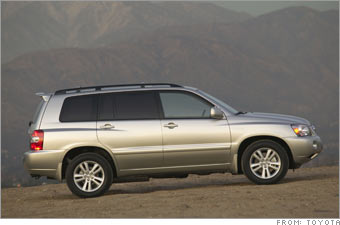
Late next year, the RAV4's "bigger" sibling, the Highlander, will be replaced by a larger, sleeker model. But in the meantime, unless you're considering the Highlander Hybrid model, the almost-as-big RAV4 may represent a better value to many shoppers.
To sum it up, the RAV4 just feels a lot more grown-up and is set up to be less of a quirky little ute and more the Camry of crossovers. The ride is settled; it's quieter and more comfortable inside; it's easier to get in and out; it's still economical; it's more carlike behind the wheel. What this means to shoppers is that the RAV4 will likely fit families that once considered it too small, and that it's a better deal than ever…with a third-row seat. Soccer moms, are you listening?
2006 Toyota RAV4
Base price: $20,300-$25,870
Engine: 2.4-liter in-line four, 166 hp/165 lb-ft; 3.5-liter V-6, 269 hp/246 lb-ft
Drivetrain: Four- or five-speed automatic transmission, front- or all-wheel drive
Length x width x height: 181.1 x 73.0 x 66.5 in
Wheelbase: 104.7 in
Curb weight: 3300-3677 lb
Fuel economy (EPA city/hwy): 20/27-24/29 mpg
Safety equipment: Dual front airbags, Vehicle Stability Control, anti-lock brakes with Electronic Brakeforce Distribution and Brake Assist, direct tire-pressure monitor; optional driver and front passenger seat-mounted side airbags, optional first and second row side curtain airbags
Major standard equipment: Air conditioning, limited-slip differential or all-wheel drive, keyless entry, power windows/locks, tilt/telescoping steering wheel, cruise control, sunroof, illuminated cupholders, dual glovebox, AM/FM/CD/MP3 sound system with miniplug input
Warranty: Three years/36,000 miles
--
src: thecarconnection.com
V-6 power in the RAV is a long time coming, but third row seats? Really?
That's what we thought when we first heard the news. How could they cram in that third row? But the RAV4 is a lot bigger. While the proportions have stayed roughly the same, truth is, the "little" RAV4 sport-utility is no longer that compact. The upsizing of the RAV4 stretches it by 14 inches overall and puts it at only about 3.5 inches shorter overall than the Highlander, with a wheelbase about two inches shorter than the Highlander. In terms of height and width, the differences are too close to call; even curb weight is comparable.
This translates to an interior that's very roomy for four adult occupants, with space for cargo, too. Toyota claims a 20-percent improvement in overall interior space, with improved head-and-shoulder room in the second row especially, but we also noticed significant improvements in front seating and the driving position. The gauge cluster and steering column are no longer angled up as much, allowing a more natural driving position for those who are of average height or taller.
If you opt for that two-position third row: beware, it's still tiny. To me the arrangement seemed like a bunch of pointless extra weight to carry around - as none of the adults present at the RAV4 preview would have been able to actually fit back there - but Toyota reps pointed out that many shoppers would be interested in having a third row for occasional, short use by parental carpools to school or soccer practice. When they're not in use, the third-row seats stow nicely in a recessed area of the cargo floor, so when they're folded down they don't actually take up a lot of space.
With its sleek, wedgy shape, the new RAV4 is considerably more handsome than the vehicle it replaces, continuing the classier feel that was started with the introduction of the second generation for 2001. The bubble-like fenders, patterned cloth, and stick shift of the first-generation RAV were long ago abandoned for a more conventional appearance (as was the stubby little two-door RAV). Much of the cosmetics and switchgear in the new RAV are borrowed from (or inspired by) the larger 4Runner and Land Cruiser sport-utilities - such dial/button climate controls, similar to what's used in the 4Runner, and the gauge faces, which look like those used across the board on Toyota's truck side.
 While the RAV4 takes many of its styling cues from the larger, truck-based Toyota utes, it also promises a more carlike driving experience than ever. The front suspension remains a strut-based arrangement, while in back there's a new trailing-double-wishbone setup, which helps keep the cargo floor as deep as possible. Helping to create a more communicative driving experience is Toyota 's Electronic Power Steering (EPS) system, which gives more road feel at all speeds.
But let's get back to the big news: the V-6 option. The RAV4 has always had enough power with the standard four-cylinder engine, but a portion of RAV4 shoppers - and of course the motoring press - have always asked for more power. It's finally here, and it's no puny V-6. The optional, engine is straight from the Avalon, basically in the same tune, and due to recalculation of SAE power figures it's now rated at 269 horsepower and 246 lb-ft of torque. The engine incorporates Toyota 's VVT-i variable valve timing system, along with a new roller-rocker concave cam profile for faster opening and closing of the valves. The six also allows some real towing ability for the first time: an optional Tow Package brings a 3500-pound capacity.
The standard engine on all RAV4s is the latest version of Toyota's ubiquitous 2.4-liter four-cylinder - available in a similar state of tune on a vast array of vehicles ranging from the Scion tC sport coupe to the bread-and-butter Camry sedan to the Highlander crossover ute.
All U.S.-bound RAV4 models have an automatic transmission,
 with no manual option, but they're very frugal. The front-wheel-drive 2.4-liter returns EPA fuel economy figures of 24 mpg city, 29 mpg highway, which is the highest in its class, not counting hybrids. And with a highway rating of 28 mpg, the V-6 RAV4 ties with the V-6 Saturn VUE for the best fuel economy among V-6 utes. Both engines will be certified for California 's ULEV II standards and are designed to run on 87-octane.
The standard four is economical, reliable, and surprisingly peppy throughout the rev range, thanks to the VVT-i variable valve timing system. Torque is decent from a standstill, provided you're not carrying a heavy load, and most of the time passing power is adequate as long as you really put the pedal to the metal. And most buyers will be happy with it. Toyota is planning on making 70 percent of RAV4s with the four-cylinder, at least initially.
That V-6 is a nice step up for hotfoots, or those who live in hilly terrain and plan to haul a full load of people and cargo on a regular basis. In truth though, it doesn't feel as overwhelmingly powerful as it seems when shopping power and torque figures. But with that much power, it's definitely a point-and-shoot affair; the RAV4 just isn't tuned for the twisties. It's not a vehicle that you'd want to drive too enthusiastically. If you try to, VSC stability control is standard, and it might help keep you on the road. Though we should add, there is a new Sport Grade model, offering firmer suspension settings and 18-inch wheels, which we didn't get a chance to sample.
The RAV4 takes VSC a step further by interfacing the system with the Electronic Power Steering system, allowing the system to provide more or less assist as needed for a particular situation. The interface goes the other way as well, with data from the steering system aiding VSC's ability to anticipate a lack of vehicle control. In addition to VSC, anti-lock brakes are standard, along with Brake Assist and Electronic Brakeforce Distribution.
 As before, the RAV4 will be available in both front- and four-wheel-drive versions, though a part-time on-demand 4WD system replaces the former full-time viscous-clutch all-wheel-drive system. 4WD versions now have a system that reverts to front-wheel-drive when there are no outstanding traction demands, for the most economical operation, though the system uses an electronic-controlled viscous coupling that sends torque (up to 45 percent) to the back wheels as needed. There's also a 4WD Lock setting that allows a set amount of torque (55/45 front/back) to be sent to all four wheels, up to 25 mph, where the Auto setting overrides it. The RAV4 has never been a serious off-roader, and the 4WD will still offer off-road performance good enough to get owners to most remote campsites and trailheads. Front-wheel-drive models come with a limited-slip differential to help aid grip in limited-traction situations.
Another electronic aid, Hill Start Assist Control (HAC), helps keep the vehicle from rolling backward when facing uphill, holding the vehicle for two to three seconds after the driver engages it with the brake pedal. Downhill Assist Control (DAC) is controlled by an in-dash switch and helps moderate speed on steep descents. Though HAC and DAC are mainly designed for off-road situations, they're standard on all V-6 models, and, oddly, on four-cylinder models with third-row seating.
The four-cylinder will still be the most popular engine choice, though;
 Toyota anticipates that about 70 percent of RAV4s will have the four and 55 percent of all RAVs will be the base "Standard Grade" trim. Initially, 56 percent will be 4WD.
But now that the RAV4 has sized up so much, there's a pretty big jump from Toyota 's Matrix hatchback to the RAV4. Almost ten years ago when the RAV4 was first introduced, its curb weight was under 2500 pounds. The V-6 Limited that we spent the most time in weighed in at a chunky 3675 lb.
Visibility isn't as good as the previous RAV4, due to a thick rear pillar and a perceived higher beltline overall. We're also curious why, considering all the standard electronic safety aids, side airbags remain an option on the RAV4, while for many of the competitors they're standard.
There are three trim levels available: Base, Sport, and Limited, with each available with the I-4 or V-6 and FWD or AWD. Even base models get a generous level of standard equipment, like an MP3-compatible CD player and a miniplug input jack for iPods or other personal audio.
The four-cylinder model will go on sale this month, while V-6 RAV4s will reach dealerships by late January. For the first two model years, RAV4s will be sourced from Japan , but beginning in 2008 Toyota will bring production online at its new Woodstock , Ontario , plant, which will eventually make the model exclusively for North America . Toyota hopes to sell 135,000 RAV4s annually in the U.S. - that's about double what the current-generation vehicle has sold yearly. Price hikes for the four-cylinder remain modest, at $20,300 for the Base Grade four, ranging up to $25,870 for the V-6 Limited.
Late next year, the RAV4's "bigger" sibling, the Highlander, will be replaced by a larger, sleeker model. But in the meantime, unless you're considering the Highlander Hybrid model, the almost-as-big RAV4 may represent a better value to many shoppers.
To sum it up, the RAV4 just feels a lot more grown-up and is set up to be less of a quirky little ute and more the Camry of crossovers. The ride is settled; it's quieter and more comfortable inside; it's easier to get in and out; it's still economical; it's more carlike behind the wheel. What this means to shoppers is that the RAV4 will likely fit families that once considered it too small, and that it's a better deal than ever…with a third-row seat. Soccer moms, are you listening?
2006 Toyota RAV4
Base price: $20,300-$25,870
Engine: 2.4-liter in-line four, 166 hp/165 lb-ft; 3.5-liter V-6, 269 hp/246 lb-ft
Drivetrain: Four- or five-speed automatic transmission, front- or all-wheel drive
Length x width x height: 181.1 x 73.0 x 66.5 in
Wheelbase: 104.7 in
Curb weight: 3300-3677 lb
Fuel economy (EPA city/hwy): 20/27-24/29 mpg
Safety equipment: Dual front airbags, Vehicle Stability Control, anti-lock brakes with Electronic Brakeforce Distribution and Brake Assist, direct tire-pressure monitor; optional driver and front passenger seat-mounted side airbags, optional first and second row side curtain airbags
Major standard equipment: Air conditioning, limited-slip differential or all-wheel drive, keyless entry, power windows/locks, tilt/telescoping steering wheel, cruise control, sunroof, illuminated cupholders, dual glovebox, AM/FM/CD/MP3 sound system with miniplug input
Warranty: Three years/36,000 miles
--
src: thecarconnection.com